Evaluate Robustness
Measure how reproducible transforms affect clean-input Performance.
Robustness reruns selected Baseline metrics on the same samples after each configured transform. The Evaluation compares each transformed value directly with its matching clean-input Baseline.
Before scoring
The selected Prediction Set must already contain Prediction Evidence for every transform and severity you intend to score. Generate a new Prediction Set if coverage is missing; an existing sealed set cannot be extended.
Configure the limit
Each transform has one Maximum allowed degradation (%) value from 0 to 100. It defaults to 20 and applies to every selected severity for that transform. A degradation equal to the maximum passes.
- Higher-is-better metric:
(Baseline - Transformed) / abs(Baseline) * 100 - Lower-is-better metric:
(Transformed - Baseline) / abs(Baseline) * 100 - A negative value means the transformed result improved.
- If both values are zero, degradation is zero.
- If the Baseline is zero and the transformed value changes, comparison is N/A.
The captured tutorial contains one Fog severity 3 comparison. Add additional severities to Prediction Generation before comparing multiple levels.
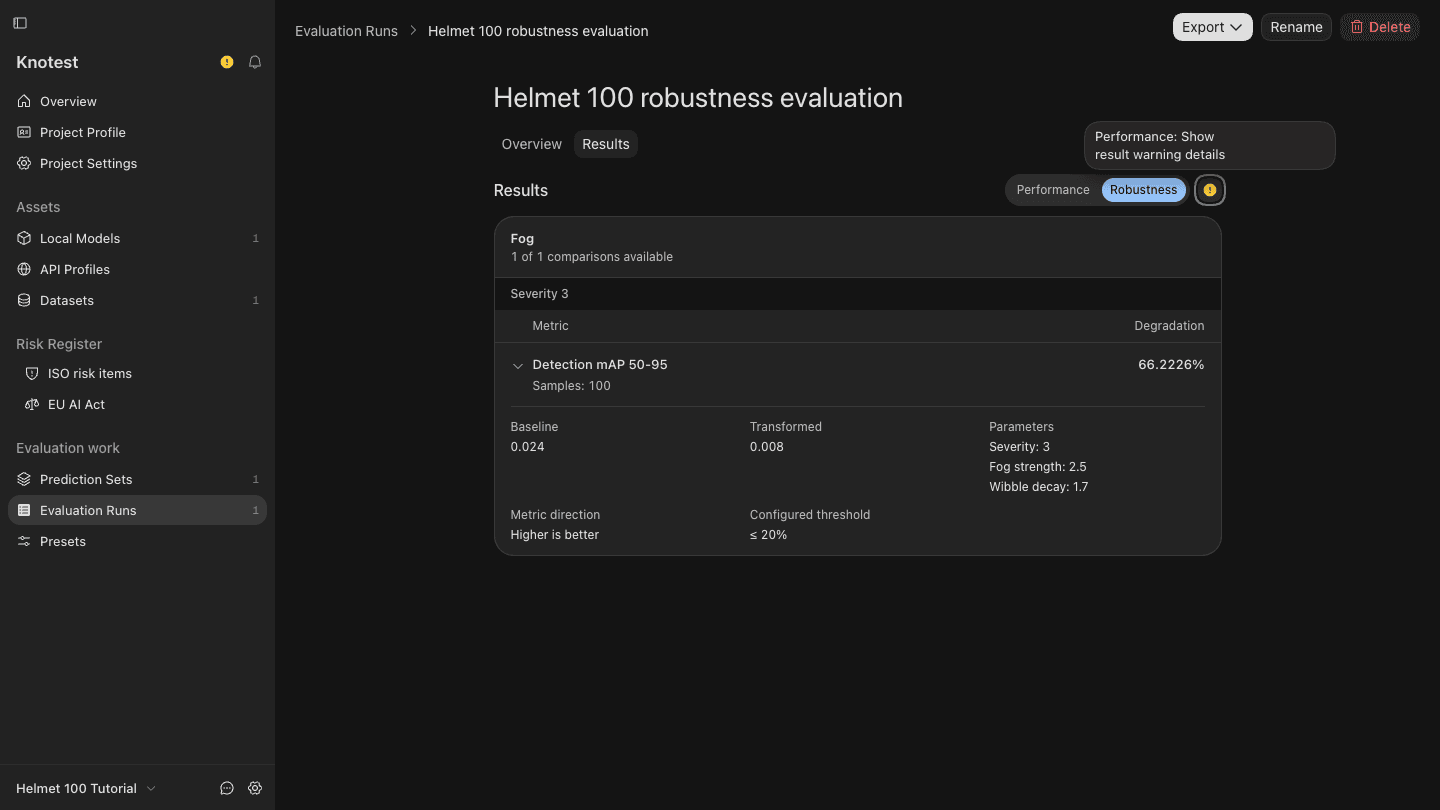
Severity is a selector, not the full reproduction contract. The PDF Report's exact settings show the resolved transform parameters and base seed.